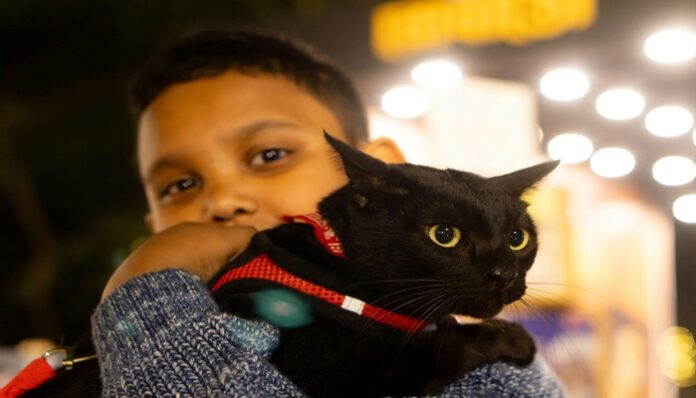
If you love an autistic child and also love animals, you’ll be happy to know that the research into cats and autistic children is mostly positive. This area of research is still developing, but it continues to provide encouraging evidence for parents.
What Do Early Studies of Cats and Autism Spectrum Disorder (ASD) Show?
Researchers generally agree that ongoing interaction between cats and autistic children has multiple benefits. Overall, the early findings indicate that cats can help reduce anxiety and stress in autistic children while modestly increasing their social connections.
A 2018 study found that cats were especially gentle and patient with the autistic children being observed. Many cats, although not all, appear to form gentle, supportive bonds with the children, particularly when the cat’s temperament suits the child’s personality and home environment.
Cats as Companions and Therapeutic Assistants
Currently, researchers are studying cats as calming companions to autistic children. In addition, socially assistive “animal robots” are increasingly being used to help autistic children better communicate, increase social interaction, and exhibit fewer repetitive and harmful behaviors.
A 2015 study, which involved a group of autistic children interacting with a robotic cat, found that the children showed higher levels of eye contact and talked more as the therapy progressed. Because children on the autism spectrum often have difficulty interpreting human facial expressions, animal faces may seem less intimidating to them.
Why Cats Are Suitable Companions for Your Autistic Child
Our feline friends, who can substitute as human companions for children on the spectrum, often form strong emotional bonds with their “little masters.” The research indicates that cats are no more aggressive towards autistic children than they are towards neurotypical children. Evidence also shows that autistic children want to hold and snuggle kitties at about the same frequency that their neurotypical peers do.
Cats are non-judgmental, offering unconditional love to children who often become isolated due to their struggles with human interaction. Autistic children love consistency, so they find cats’ gentle, steady purring and predictable behaviors comforting.
How Cats Benefit Autistic Children
- A cat’s unconditional love and acceptance can strengthen an autistic child’s self-confidence.
- The pleasing sensory experience of holding and cuddling a cat may help children on the autism spectrum feel more grounded.
- Brushing and petting a cat releases calming endorphins in children. The task of grooming a cat provides a sense of responsibility while increasing self-esteem.
- Spending time with a cat lowers the stress hormone, cortisol, which reduces autistic children’s anxiety.
- The empathy that an autistic child can gain from interacting with an adopted shelter cat may reduce bullying, hyperactivity, inattention, and separation anxiety.
- A 2018 study, based on parents’ observations, concluded that talking to cats has the potential to improve autistic children’s language skills.
- Interacting with cats can help children on the spectrum practice reading non-verbal signals in a low-pressure environment.
- Talking to friends and family members about their kitties can help children socially connect with others.
How to Select the Right Kitty for Your Child
Select an affectionate, gentle cat with an easygoing disposition, such as a Maine Coon, Ragdoll, Siberian, British Shorthair, Birman, or Ragamuffin. Some research shows that many of the cats who are gentle with children on the spectrum were adopted as kittens. The cat should be playful, outgoing, and able to tolerate petting and sudden movements. Most importantly, match your child’s own personality and desires to the cat’s tolerance for holding, petting, cuddling, and playing.
While the research on how cats benefit autistic children isn’t yet comprehensive, the evidence is encouraging. Studies suggest that having a cat companion with the right temperament may help autistic children reduce anxiety and increase social connection.
So why not consult a therapist or doctor about the possibility of finding a gentle, affectionate kitty for your autistic child? A temperament-screened cat with a lot of love to give could be exactly what your child and family need to thrive.
Featured Photo by Ashraful Islam on Unsplash.