
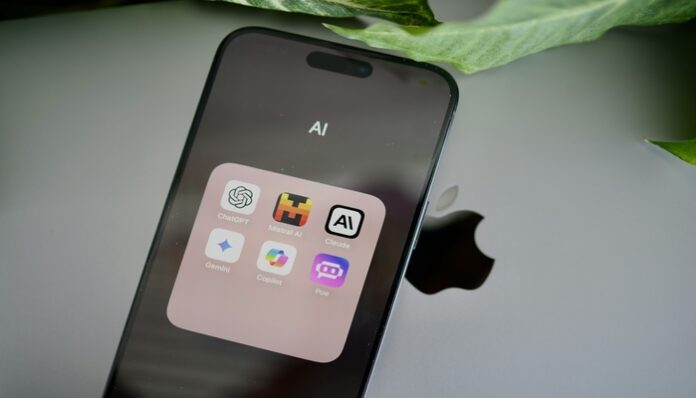
Every time I watch my favorite shows, I see a flood of advertisements for artificial intelligence (AI) products and services. These commercials claim that we can write emails with AI, use AI to research our favorite topics, and even buy phones and cars with built-in AI systems. Artificial intelligence is present in every aspect of our lives, from work to leisure to everything in between.
Of course, AI is nothing new — we’ve had artificial intelligence technology for years.
Artificial intelligence programs take inputs — whether they’re user-based or scraped from the internet — and find patterns so that the systems can make relevant outputs. Cleverbot was one of the first widespread AI systems, and later, Siri came along and popularized using AI in our daily lives.
My problem with AI is that I feel that its name misrepresents it.
AI is artificial, but is it intelligent?
To me, artificial intelligence feels more like “auto-fill.”
If artificial intelligence technology were truly intelligent, it would be able to write you a book without needing you to give it a prompt. But AI systems still rely on people to tell them what to do, and they can’t come up with ideas or opinions of their own. There’s no intelligence in trying to mimic patterns that are as random as human input.
This is especially a problem with regard to AI-produced art, novels, music, and creative works. If I post my art online, someone could feed it to an artificial intelligence program and have it spit out a new original in my style. But would that piece of art still have the thoughtful details that I included in my own art? Would it have the same emotion tied to the color choices? Would it have a rich backstory? We don’t make art solely for consumption; we also make it for emotional expression. What will happen to art if it all stems from mass-produced, low-effort AI prompts?
Art isn’t the only problem, either. What happens when employees exclusively rely on AI to write their work emails, like these advertisements suggest? It fills me with rage that someone with a professional office job can now blow off the simplest tasks and refuse to learn important life skills, like writing professional emails. Why hire employees for high-level positions when they’ll just use AI to do their work for them? What will happen to society when we stop using and honing these critical skills?
To ensure that I’m not just an “AI hater,” I asked three other people for their opinions about artificial intelligence. Respectively, they are a senior computer programmer, a millennial roommate of mine, and a hip youth who knows whether current trends are hot or not. Here’s what they said:
“[AI is] annoying. People seem to be putting it into everything just because they can, even when there’s no point. Why does my Messenger chat have [the] ‘Ask Meta AI’ [feature]? What’s the point of that? It’s also premature… [Artificial intelligence] will probably also cause the end of civilization, and there’s no way to stop it. I’m not sure if that’s hyperbole or not.”
-Edward Demko, senior software engineer
“People credit [artificial intelligence] with more than it’s actually technologically capable of, which is annoying, and [its] environmental impact is bad.”
-Greg, millennial roommate
“I think that AI not only has horrible environmental effects due to the high maintenance servers it’s hosted on, but [it] is taking jobs away from real, talented artists, forcing them into ‘regular’ and monotonous jobs that could easily be done by AI or computers.”
-Katarina, 17 year old hip youth
Clearly, there’s a multi-generational pushback against AI. So why is it slowly overtaking every product, every service, and every website and commercial?
The surge of corporate enthusiasm for AI boils down to the simple cost-effectiveness of not having to pay actual employees. Working-class America should fear this trajectory.
This is the canary in the coal mine.
We can be wary of how good these “auto-fill” programs are without having knee-jerk responses to all new innovations. You don’t have to be a conspiracy theorist who believes in the fall of civilization in order to criticize the harmful effect that AI has on our lives and futures. Ask yourself who stands to gain from this technology. The reality is that with artificial intelligence, we have so much to lose.
Featured Photo by Solen Feyissa on Unsplash.



















Good luck
Thats ok
Simplifying AI discovery for everyone. Find tools, read expert insights, and stay ahead of the AI curve with TopAITrends.io.
Web Application Penetration Testing is crucial for businesses in Chennai to defend against cyber threats and data breaches. With the increasing complexity of cyberattacks, ensuring robust security measures is essential. Penetolabs provides expert security testing services, identifying vulnerabilities and Web Application Penetration Testing in Chennai fortifying web applications against potential exploits. Their comprehensive approach helps businesses enhance security, maintain compliance, and protect sensitive data. For organizations in Chennai looking for reliable cybersecurity solutions, Penetolabs is a trusted partner in web application security and risk mitigation.
I couldn’t access the article directly, but if it questions AI’s intelligence, it’s a thought-provoking topic. Many argue that AI’s capabilities are limited to programmed responses without true understanding or consciousness. This raises valid points about the nature of intelligence. For trending sounds and downloads, check out SoundBoardW.com for the latest updates!
I found this article thought-provoking, especially its critique of AI limitations. Personally, I’ve had a much better experience with DeepSeek at https://deepseekdeutsch.io/, it’s surprisingly intuitive and handles complex conversations far better than expected.
This is an interesting perspective on artificial intelligence. It is true that while AI has made great progress, there is still a huge gap compared to true human intelligence. I wonder what aspects AI research groups around the world, including those in Italy like DeepSeek
( https://deepseekitaliano.net/ ), are focusing on to close this gap? Do they have any unique approaches to developing smarter and more ‘real’ AI systems? There needs to be more in-depth discussion and research on this topic.