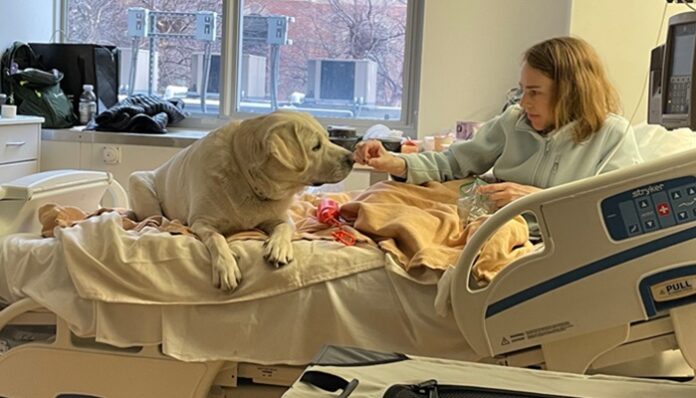
I just spent time in the hospital due to sepsis from two different bacteria in my bloodstream. For the first five days, while the infected central line was still in, I was entirely off nutrition. I was experiencing shakes and chills, vomiting, nausea, crying, sweating, and rigors. I was very sick.
Then my recovery coach came to visit on day 5 for two hours, and I cried the whole time. I told her how I didn’t want to die, but I also didn’t want to be away from my service dog in a cramped hospital room, feeling miserable. I didn’t want to exist, but I didn’t want to die because that would be detrimental to my family and dog.
When I literally couldn’t stop crying, the charge nurse came in and gave me Ativan to calm down.
She then sat with me and my recovery coach, who told her how my service dog helps me. He is a medical alert and response service dog. He had never been to the hospital since he just completed his training program last November, and he’s still not even two years old. But I was missing him so much that my recovery coach encouraged me to ask for him to be allowed to come.
I was assigned to a great hospitalist, and the charge nurse promptly moved me to a private room, approved my service dog to stay with me, and ensured that I was assigned nurses who were knowledgeable about TPN and PPN (my IV nutrition). We put a sign on the door that said “Do not knock—service dog. Enter slowly.” That was essential because my service dog is trained to bark when people knock on the door, alerting me that someone is there. But as long as he was working at the hospital, he wasn’t allowed to bark. So this sign helped a lot.
My doctor was fabulous and totally understood the trauma associated with my illnesses, the misdiagnoses, and the gaslighting from doctors belittling my pain. I felt validated and seen by this excellent healthcare professional.
When my service dog arrived, I was so excited that my telemetry heart monitor went off the charts!
He not only brought me a lot of comfort but also lifted the spirits of the nurses. We had a steady stream of nurses coming in periodically looking for my dog. And each nurse who met him brought friends. Because of that, I was fought over when the nurses were assigned their patients.
When it came to taking walks, my service dog was fine with total strangers I found on the Rover app. I also had one of my regular dog walkers come to the hospital. A friend walked him one day, and my parents walked him on other days.
I quickly trained my dog to jump on the bed with me if he was afraid of anyone who came into the room. If he felt comfortable with the person entering, he would grab a toy and jump off the bed to bring it to them.
Through my experience, I have gained valuable insights into the benefits of having a service dog accompany you during hospital stays. Ifed. So, if you have a service dog and need to be hospitalized, here are some things I’ve learned that may be helpful.
1. If your dog barks when someone knocks, ask for a sign on your door that reads “Service dog. Do not knock. Enter slowly.”
This can make your hospital day stay more manageable and less stressful for everyone involved.
2. Rover dog walking app is beneficial.
Everyone wants to walk a well-trained service dog. Now, I’m actually having one of the Rover walkers come to my condo regularly on the weekends because she was so good with my service dog.
3. Make sure you clear bringing your service dog with the charge nurse.
Unless you bring the dog in through the emergency room, it’s essential to obtain permission beforehand. Personally, I wouldn’t bring my service dog to the ER because they are constantly taking you for tests. Plus, sometimes you’re in the hallway at my hospital because there are no beds available due to overflow. But once I’m admitted, I’d have him come right away.
3. Sometimes, you may need to wait a few days before receiving your service dog.
I learned I couldn’t have him for the first five days because I was too sick even to pet him. I recommend hiring a dog sitter while you are very ill and undergoing tests, so that your dog isn’t alone for several hours.
4. Nurses are so grateful when they can come in and pet a well-behaved dog.
They often cry, then kiss your dog, and return to work. If your dog is OK with being pet while in your room, the nurses would greatly appreciate it, especially on hard days. I’m going to train my service dog to be a therapy dog for the nurses at the hospital, since Blizzard loved them all so much. The charge nurse told me to bring him back in for some nurse therapy next week.
5. You get your own room if you have a service dog.
But if your dog is not perfectly well-behaved (even mini barks, unless tasking, count), they will kick him out in a heartbeat.
6. Bring your service dog in for visits before having him stay overnight.
This would have benefited my dog. I had walked him through the halls before, but we had never gone into a patient’s room. My parents didn’t want to bring him in while I was hospitalized earlier this year, and then have to take him home. It would have been too hard on both of us. So we took a big leap of faith, and it worked out beautifully!
7. Bring a crate for your service dog.
Make sure to crate your service dog for the night. It lets the nurses and CNAs focus on you, the patient, without having to worry about dealing with a dog in the dark while you’re asleep. Bliz didn’t make a peep all night next to me in his crate. I’m so glad he’s crate-trained and feels safe in there.
8. Please speak with the charge nurse if you need anything.
I got a soft-touch call button because I was too sick one night to press the call bell. It’s easier when you’re suffering just to hit it, rather than find the tiny button that is hard to push just right.
9. Have each nurse and CNA come into the room before you go to sleep to greet your service dog.
That way, you can ensure it’s a good fit for the night or day.
10. Having a service dog during hospital days is incredibly healing.
If you have a legitimate service dog that has completed a professional service dog training program and graduated, and also holds their CGC title, having your dog in the hospital can be incredibly healing. You need to ensure your dog is comfortable with IV poles, IVs, lines, and the associated hospital noises. But if your dog is mature enough to handle it, it makes all the difference. I didn’t need rescue meds after he came. And my nightmares went away once he was beside me at night.
11. Lastly, if your dog is for emotional support, do not take advantage of the laws.
If your dog hasn’t been properly trained by a program or professional, please refrain from taking advantage of the laws and pretending to have a service dog in a hospital setting. I understand it’s hard to be without them, but it ruins it for all of us with truly well-behaved service dogs when a fake comes in and barks, giving service dogs a bad name.
Blizzard was told he’s the best-trained service dog they’ve ever had on the floor. I believe it because he’s exceptional for his age. However, I know people often circumvent the laws for emotional support. But if it’s not a legitimate service dog, it really dampens the whole experience for everyone.
Featured image via author