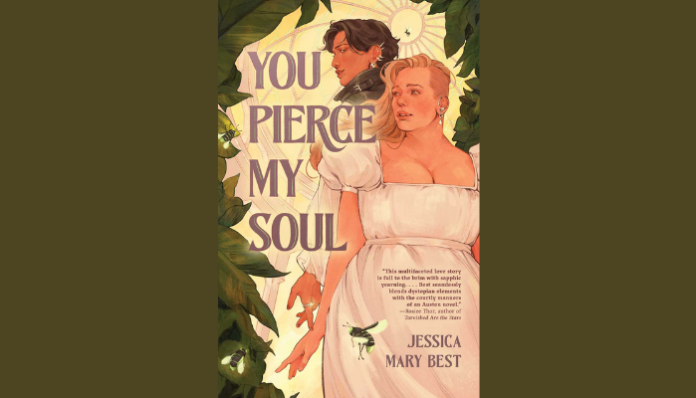
Jessica Mary Best’s “You Pierce My Soul,” released on May 5, 2026, is an engaging dystopian novel that tackles themes of privacy and data collection. While not quite on par with classics such as “The Giver,” it is enjoyable in its own right and hard to put down.
In “You Pierce My Soul,” 18-year-old Zada is excited to finally be matched with the love of her life. Heartsong, an algorithm developed by the utopian society of New Ionia, bases everyone’s matches on data collected from its citizens, eliminating the trouble of looking for love on your own and the heartbreak that comes with it.
However, when Zada finally meets her match, she feels no attraction to him. Desperate, she reaches out to her ex-friend, Daphne, to uncover the truth about Heartsong. Along the way, she uncovers dark truths about her world and feelings she never knew she had for Daphne.
As a dystopian novel, “You Pierce My Soul” does a fairly good job of exploring its themes.
New Ionia has painted the data it gathers on citizens as a way to help people find their perfect soulmates, jobs, and other things in life, but Zada and Daphne slowly discover that this, too, erodes their free will.
It gets you thinking about the price of freedom versus the convenience of having someone else make decisions for you, which feels especially timely as major tech companies face criticism for collecting and selling user data for personal gain.
The novel does struggle with world-building, leaving more questions than answers.
New Ionia harkens back to some older traditions, such as arranged marriages, yet also uses new technology such as Heartsong. While a mix-and-match of old and new tech isn’t necessarily odd, it’s not explained why they chose to go back to tradition in some areas but not in others.
Additionally, accepting queer people feels odd for a dystopian society that prides itself on reviving tradition. New Ionia acknowledges and accepts nonbinary people and those with same-gender attraction, which clashes with its emphasis on tradition. Anything old-fashioned would not accept queer people, so it feels odd that homophobia isn’t a present issue here. In fact, anti-queer sentiment in general seems nonexistent here, which feels unrealistic.
The novel also doesn’t address what happens to asexual, aromantic, and other people on the ace spectrum.
If they accept queer people, you would think this would include ace people, but New Ionia expects people to be with their matches. There are serious repercussions if you don’t agree with your match.
The fact that “You Pierce My Soul” acknowledges many queer people but not ace people feels like ace erasure. Even if it was unintentional, it strikes as particularly glaring in a dystopian society that seemingly accepts other queer people.
Luckily, “You Pierce My Soul” excels in other aspects of the novel. Zada and Daphne are both relatable and believable. Their banter feels natural and makes it easy to root for their relationship. Their history as friends also adds an interesting layer of complexity to their dynamic.
Zada and Daphne’s fun dynamic makes the novel even more enjoyable as we learn the secrets of New Ionia alongside them.
The novel delivers well on an interesting mystery that reveals unexpected truths and keeps you turning the page with its fast pace.
While “You Pierce My Soul” is not the most developed dystopian novel, and I wish it had addressed and represented ace people, it does have a lot going for it. Zada and Daphne are engaging characters with a great relationship, and the novel tackles privacy in a way I haven’t seen before.
If you’re looking for a standalone dystopian novel with queer representation that explores personal data and privacy, check out “You Pierce My Soul,” available in bookstores and online today.
Featured image via Simon & Schuster