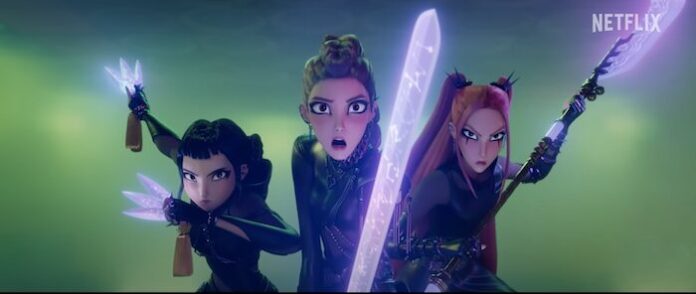
When I met with a friend a few weeks ago and told her I had recently watched “K-Pop Demon Hunters,” she vibrated with excitement. She told me that, when it first came out, she watched it 7 times. And she’s far from the only one who’s obsessed.
Many netizens wonder how this movie did so well. Some guess that the name helped. If you enter a movie with low expectations, but it exceeds them, you remember it as a pleasant surprise. Some also said that it succeeded because it’s the kind of original passion project that moviegoers, drowning in endless sequels and remakes, were yearning for. Others have said it’s because the songs are just that good.
These theories are valid. But I think part of why this movie resonated with so many people is that it has a powerful message about overcoming shame – a message that I think a lot of people needed to hear.
Warning: Spoilers ahead!
The “K-Pop Demon Hunters” film follows three women – Rumi, Mira, and Zoey – who are billionaire K-Pop idols by day and demon hunters by night. For generations, hunters like them have used their singing to inspire others, which prevents demons from coming to Earth. However, Rumi hides a secret from her friends – she is part demon. She tries to “fix” herself, but, throughout the movie, things happen that force her to confront the truth of who she is.
Throughout this movie, there’s the question of what defines a person, which we can all relate to.
Rumi meets another demon, Jinu, who sees himself as nothing more than a demon, defined by the selfish act that corrupted his soul. In the 400 years since then, he developed a pattern of external selfishness and internal self-loathing. Rumi struggles to define herself, torn between the strong hunter and idol she feels she should be, and her darker secrets. All the while, the main villain of the movie, Gwi-Ma, the king of demons, keeps his subjects in line and captures human souls by preying on their insecurities.
Eventually, instead of fighting or defeating the demon part of her, Rumi saves the world by embracing all of herself.
Tons of children’s movies indeed talk about accepting yourself. However, what makes “K-Pop Demon Hunters” stand out is its refusal to demonize people for their worst actions. Instead, it meets them where they are. The movie shows that, while they may make bad choices, they all have understandable reasons for doing so.
Rumi lies to her closest friends for years, but she does it because she’s scared of losing them. Jinu betrays a lot of people, but he does so out of desperation for a better life. And, when Mira and Zoey find out Rumi is part demon, they raise weapons at her — but they clearly don’t want to hurt her, and only do it because people taught them since birth that demons were inherently evil.
In “K-Pop Demon Hunters,” the filmmakers push the genuine, earnest message that people are more than their mistakes, past, or surface-level identities. And I think we all need to hear that right now.
In the age of the internet, so many of our thoughts and actions are public. While this allows people to hold others accountable more easily, it also means that, through cancel culture, we bring up people’s pasts over and over, not considering the possibility of change. You can see similar things in online fandom spaces all the time – if a book, movie, or TV series contains something “problematic,” it obviously “glorifies” that thing, so we should burn the creator and their fans at the stake.
While this movie has found success worldwide, I doubt I’m the only American viewer who likes how powerfully this movie’s message is, how it contradicts the discrimination and shaming in current U.S. politics. In all of these ways, modern life feels like a constant war of shaming- and in the middle of that, this movie feels like a breath of relief.
Although “K-Pop Demon Hunters” is an animated kids’ movie with an odd name, and mainly veers between badass songs and being (wonderfully) comedic 90% of the time, we need to pay attention to what it’s saying underneath. This film offers a hopeful, human message, one that I think could help a lot of people if they choose to believe it.
Featured image via “K-Pop Demon Hunters” trailer screengrab