
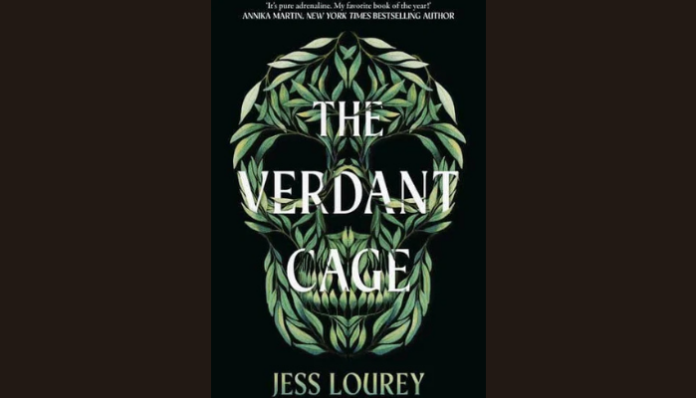
I had the pleasure of receiving an advanced reader copy (ARC) of Jess Lourey’s young adult dystopian thriller, “The Verdant Cage,” which officially released on April 7, 2026. The story centers on 17-year-old Rose Allgood, who lives within the Wall in Noah’s Valley, a barrier designed to protect people from the outside world. Growing up, her mother told her to keep her head down and never to question the rules.
However, everything changes when Rose’s mother is murdered—and the government accuses her brother of killing her. With her mother gone and her brother outcast, Rose races to find her mother’s killer and prove her brother’s innocence. Along the way, she uncovers secrets about the world she thought she knew.
“The Verdant Cage” is a fast-paced, thrilling dystopian novel that I was excited to pick up as someone who grew up during the young adult dystopian novel trend of the 2010s.
The murder mystery, Rose’s investigation, and the short chapters make “The Verdant Cage” a page-turner from start to finish. There’s a sense of urgency from the dangers and secrets lurking everywhere, so there’s never a dull moment while reading, nor does the book feel slow.
The characters, while fairly predictable for the genre, are likable as a whole, which makes this story easier to read.
Rose is a pretty typical protagonist for this genre. The novel sometimes relies more on telling than on showing, which undermines Rose’s development into a more well-rounded character. However, you find it easy to empathize with her after she loses both her brother and mother on the same day. You root for her the entire time as she tries to uncover the secrets of the society she lives in, all to clear her brother’s name and stop the murderer who took her mother’s life. She navigates grief, anger, and hope—qualities that make her a relatable protagonist to root for.
Gryphon fits the typical love interest who acts like a jerk but has more depth underneath, though their twist of him originally being friends with Rose is interesting. As for the rest of the cast of characters, the story introduces them a bit abruptly throughout the novel, and they mostly stay to the side. However, they have their quirks and exhibit some typical teenage behavior, adding another layer of realism to the book that I appreciated.
One of the biggest things that works for “The Verdant Cage” —and against it— is how fast-paced it is.
In terms of world-building, the book introduces many concepts quickly—like the different Houses and some of Noah’s Valley’s rules that we encounter throughout the story—that aren’t fully explained. The book presents them so rapidly that it’s hard to process everything. This also applies to Noah’s Valley as a whole. While the story raises interesting topics about a brutal government exercising total control, hierarchies, and classism, I felt like the book didn’t explore these concepts in detail due to the novel’s fast pace. Although this quick pacing makes this an intriguing and exciting read, it could benefit from slowing down in several areas.
This also applies to the characters. Rose’s development as a character feels rushed and nonlinear, and her relationship with Gryphon feels similar. And, as mentioned earlier, the side characters are introduced a bit abruptly, making it hard to keep track of them. You don’t get a real chance to know them, and their relationship with Rose feels rushed. There’s not enough time to get to know them, given the fast pace of the novel, which seems like a missed opportunity.
Overall, I enjoyed reading “The Verdant Cage” and found it to be a page-turner.
I’m glad to see a throwback to the young adult dystopian novels I loved growing up. The book’s greatest strength is its fast-paced, suspenseful pacing, but it also hurts the book by spending less time developing characters and Noah’s Valley as a whole. It doesn’t stick with me the way novels like “The Hunger Games” or “The Giver” did, but I enjoyed it overall and found it an exciting novel that was hard to put down.
You can find the novel on Amazon and in bookstores today.
Featured image of book cover courtesy of the author and Entangled Publishing



















[…] This review was originally published on Unwritten […]