
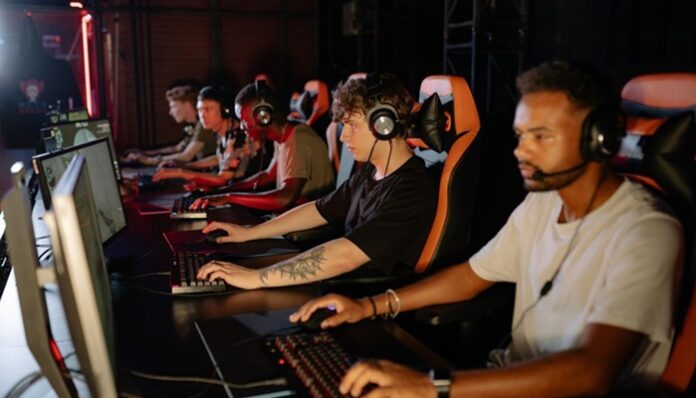
For years, people have debated whether or not esports (electronic sports) should be considered a legitimate sport on the same level as hockey or football. It’s easy to see why. Esports—competitive video gaming—doesn’t involve the same level of physical activity and strict workout regimens as traditional sports and relies heavily on technology.
But I believe that, with its recent growth into a powerhouse industry and its promise of further development, it’s both a legitimate sport and a viable career path. But what exactly is a legitimate sport in the first place? The definition of a sport can be vague and vary on a case-by-case basis, but it still hinges on a few essential traits. Here are some ways that esports embodies these traits, and why it should be a “real” sport.
1. It requires skilled physical activity.
Esports requires a surprising amount of physical and mental discipline, like a split-second reaction time, hand-eye coordination, and the ability to keep cool under pressure, which are essential traits shared by top athletes in other sports. Faker, one of the most iconic professional League of Legends players in the world, boasts reaction times comparable to those of Formula One drivers.
In certain cases, it also requires a lot of team strategy, communication, and coordination, as most big competitive video games are team-based. Each player in a team has their own specialized skillset or position, and, just like other sports, they have long training periods with the team trying out new strategies or formations. This mirrors the requirements of a traditional sports team.
2. It involves a huge amount of money and media exposure.
According to Yahoo Finance, the global esports market size is projected to grow from around 10 billion USD to 55 billion USD in the next 10 years. That’s a lot of money! The article also lists several global government initiatives and funds being invested in the esports scene to further promote the growth of the industry worldwide.
Additionally, top athletes in the esports industry are often paid in the millions, with their games televised across both television networks and online streaming services like Twitch and YouTube.
3. It’s produced iconic athletes and stars.
Every big sport has standout names. These are the figures that even people who don’t necessarily follow the sport know—for example, basketball has Michael Jordan and LeBron James, soccer has Lionel Messi and Cristiano Ronaldo, and golf has Tiger Woods.
Esports is no different. It boasts a variety of names who are the best in their respective competitive games, but by far the most universally well-known is Faker. If you’ve heard of the game League of Legends, you’ve probably heard of him. South Korean professional athlete Faker is widely considered the greatest LoL player in the world, with nearly 20 wins in the biggest global tournaments and countless MVP accolades. He is estimated to earn multiple millions annually.
To speak further on the influence of his name, he’s one of the top-marketed figures in esports. Faker has partnerships with Nike, Red Bull, Razer, and more global brands. He has also appeared in K-pop music videos and is frequently cited alongside BTS as one of Korea’s greatest cultural exports.
4. It’s now included in the same categories as traditional sports.
Esports has been in discussion to be included in the upcoming Olympic Games, giving the industry further legitimacy as a sport. Currently, the IOC (International Olympic Committee) plans to host the Olympic Esports Games in 2027, focusing on events that mirror real-life sports featured in the Olympics, such as basketball and soccer.
While it’s definitely a departure from traditional sports, I still think it’s made a name for itself in this technology-forward world. And I definitely see it growing more and more as video games become more refined and advanced in the future, the sort of growth that is unique only to this form of competition. But what do you think—should esports be considered a “real” sport?
Featured image via Yan Krukau on Pexels



















The passionate debate over classifying competitive gaming alongside traditional athletics really highlights how much our perception of strategy and high-stakes performance has evolved recently. Whether analyzing pixel-perfect mechanical execution or elite stadium teamwork, the core need for deep statistical evaluation remains exactly the same. Diving into that analytical side of sports has been fantastic for me since I started using worldcuppredictions.today to access comprehensive historical form guides, detailed tournament tracking, and expert squad breakdowns. Relying on their structured performance metrics and daily data overviews has completely streamlined how I follow major international competitions.
I have been watching old VODs from the FACEIT Major London 2018 and it is amazing how well that tournament still holds up. The event was held at the SSE Arena, Wembley, with over 10,000 fans in attendance and millions watching online. The format was massive, with open qualifiers, closed qualifiers, minors, and then the Challengers, Legends, and Champions stages. The top teams at the time included Cloud9, FaZe, MIBR, Na’Vi, Fnatic, G2, and many others. The production was top tier and the atmosphere was electric. The site also hosted live streams, pubstomp viewing parties worldwide, and had dedicated VODs on YouTube. If you want to look back at one of the most iconic CS:GO majors ever held, check out https://faceitmajor.com/. It is a great way to revisit the matches and the build up to the champions. I have been rewatching some of the classic moments and they still give me chills.