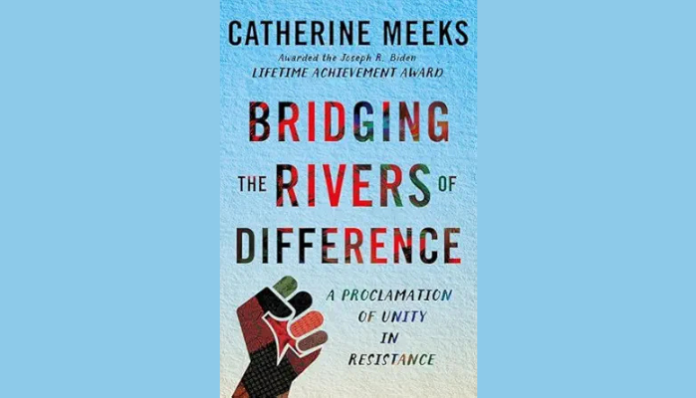
Following our recent review of “Bridging the Rivers of Difference: A Proclamation of Unity in Resistance,” we sat down with the author, Dr. Catherine Meeks, to dig deeper into the book’s most pressing themes. Drawing from over fifty years of grassroots activism in America, Dr. Meeks shares her sharp insights on dismantling performative corporate culture, overcoming the “oppression Olympics,” sustaining energy in the face of political fatigue, and why true resistance begins at the dinner table.
1. On Corporate DEI
Interviewer: In “Bridging the Rivers of Difference,” you explained that corporate Diversity, Equity, and Inclusion (DEI) is typically superficial — not changing how the system actually works. What does actual institutional change look like to you?
Dr. Meeks: When there is a serious intention to change the workplace in ways that make it more diverse, equal, and inclusive, the work needs to begin by changing the makeup of the board of directors, the upper-level management, and any other portions of the system where the power actually lies. When you see this type of internal reorganization, it is correct to conclude that the [company] is serious about change.
Then, when there is an announcement about the appointment of a Vice President for DEI, it is much easier to believe that person might have a chance to do significant and important work. Otherwise, when [companies make] those appointments without the substantive structural changes I noted, they become mere superficial, performative acts.
2. On the “Oppression Olympics”
Interviewer: It’s common for different marginalized groups to compete over whose trauma is worse, which you call the “oppression Olympics.” How can we break out of that mindset so that we can support each other’s histories instead of fighting?
Dr. Meeks: That is a good question. I think that we begin by acknowledging the suffering of each group as something to respect. It is a negative use of energy to try to quantify how much one person’s suffering [should] be valued over another person’s. [We can’t quantify] suffering from marginalization and oppression, and when groups attempt to do so, it simply creates more pain.
I believe that we have to create spaces where members of marginalized groups can come together and begin to tell [their respective] stories. We must work on becoming more respectful of the suffering that each group has endured, learn to name the real oppressors, and stop seeing [each other] as enemies… From there, we have to find the common threads that tie us together and seek out common agendas that we are genuinely willing to work together to achieve. We have a lot of work to do to get to this place, but I believe that it is completely possible.
3. On Activism Fatigue
Interviewer: Looking at the political landscape right now, with Project 2025 in full force and politicians stripping people of their rights, many young people feel hopeless. What’s your advice for staying grounded without completely burning out?
Dr. Meeks: Thank you for asking this very important question. First of all, young people need to have as much contact as possible with older generations, as well as with those who are even younger than they are. Intergenerational energy is so vital. The younger people help you… maintain hope as you look at things through their fresh lenses, while the older people can help you see that you can survive far more than you might have imagined possible.
When you have lived to be 60, 70, or 80 years old, you have seen a lot, and you know that you can endure a lot. But there are days when it seems unlikely that you can take any more. Then, you suddenly discover that you can [keep going] because some unexpected energy, gift, or reason to hope [appears] and helps you get up just one more time.
[Additionally], young folks need to work on defining what they really believe. What hills are you willing to die on, and which ones are you willing to let go? You cannot fight every battle, and there are certain battles that [you will lose] because it is sometimes necessary to lose a battle in order to win the war.
Along with developing deep inner clarity and an unshakeable inner core, stay connected to beauty and creativity. Find the things that make you smile and that help you come alive, and do not let go of them. For [instance], I make greeting cards from handmade paper and fabric, I play with essential oils to make custom perfume blends, and I pour scented candles. I also enjoy painting mandalas and other designs in coloring books. I keep a journal, I pray, and I work very hard every day to stay connected to that creative spark. Beauty will save your life.
4. On the Grassroots Blueprint
Interviewer: Your epilogue offers a brilliant blueprint: creating small, local cohorts of 20 to 30 people to share autobiographies, study ancestral histories, and share food. Why must true, sustainable resistance start with human storytelling instead of immediate political action?
Dr. Meeks: Political action that does not have a strong, sustainable community foundation simply will not last. Across our history in the United States, we see the results of political action that wasn’t grounded enough — it inevitably becomes a target to be attacked relentlessly. Voting rights [are] a prime example. The issue of voting rights in this country should not even be on the table for discussion at this point in time, but because we did not do it correctly the first time, we have to keep working [to fix] it today.
If we can build these strong “cells” of community resistors who create clear liberation agendas and support them alongside elected leaders, we can ensure that when [our work] is finally put into law, it stays fixed. That is how we vacate the kind of chaos we see these days in the political arena.
We need strong community support to foster effective political action. We have to move beyond having a bunch of “allies” who are present for the short run but [are] nowhere to be found when things really get hard. They do not remain for the long pilgrimage to justice. However, communities that fundamentally respect and care for one another will stick around for that long journey, and their political action will always have a far better foundation than action built without serious community commitment.
Featured Photo via Amazon.